Spring is a season of rebirth and a time when special attention should be paid to health preservation. So, what vegetables are good to eat in the spring? Be sure to cook these vegetables for your family!
In ancient times, Confucius advised us, "不时,不食" (bù shí, bù shí), which roughly means, do not eat fruits and vegetables that are not in season. Seasonal vegetables are also considered "lucky vegetables." Food should emphasize its "qi" (vital energy) and its "flavor." Because food and medicine are both composed of qi and flavor, and the qi and flavor of food and medicine can only be fully absorbed when they are in season, that is, when they grow and mature in accordance with the solar terms.
Spring seasonal vegetables include chives for nourishing yang, bean sprouts, lettuce, scallions, pea shoots, and garlic shoots for promoting the vitality of life; and late-spring fruits that nourish the liver and lungs, such as strawberries, green plums, apricots, plums, mulberries, and cherries. Below, we introduce 10 seasonal foods for spring health preservation.
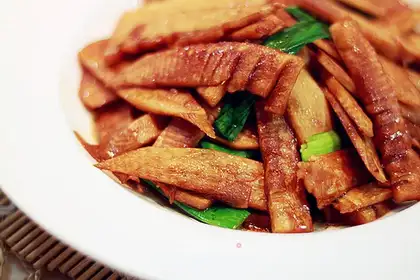
Braised Spring Bamboo Shoots
1. Spring Bamboo Shoots
When it comes to spring eating, spring bamboo shoots cannot be missed. Spring bamboo shoots are crisp, tender, and delicious, with a fresh and mellow fragrance, earning them the title "the finest among vegetarian foods." They have been beloved by people since ancient times, and writers and gourmands have praised them endlessly, with the saying, "尝鲜无不道春笋" (cháng xiān wú bù dào chūn sǔn), meaning "those who taste the fresh delicacies all speak of spring bamboo shoots." If meat-eaters are considered vulgar, then eating bamboo shoots is the complete opposite.
The taste of bamboo shoots is considered elegant and enduring. According to modern Traditional Chinese Medicine, spring bamboo shoots have the effects of "benefiting the nine orifices, promoting blood circulation, resolving phlegm, and eliminating food stagnation."
2. Toon (Chinese Cedar)
There is also a folk saying, "三月八,吃椿芽儿" (sān yuè bā, chī chūn yār), meaning "On the eighth day of the third lunar month, eat toon buds." Every year in the third lunar month, it is the prime season for toon buds. Toon can be used in cooking to create various specialty dishes and also has disease-preventing and therapeutic effects, making it a natural, green, health-preserving food that is both medicine and cuisine.
Toon is also rich in protein, vitamin E, calcium, phosphorus, iron, and other elements, making it the champion of vegetables. The tender buds of toon can be made into various dishes, with the new branches and young leaves having the best texture. It is delicious and aromatic, and can also stimulate appetite, nourish the skin, and promote beauty.
3. Cherries
Eating cherries in the spring can induce sweating, replenish qi, expel wind, and promote the eruption of rashes. Cherries are hailed as "the first branch of spring fruits." Cherry flesh is thick, delicious, and juicy, with a bright color and rich nutrition. Its iron content is particularly outstanding, more than 20 times that of citrus, pears, and apples, ranking it first among fruits. Cherries are warm in nature, sweet and slightly sour in taste, and have the effects of tonifying the middle jiao, regulating the complexion, and strengthening the spleen and stimulating the appetite.
4. Strawberries
Among anti-cancer fruits, strawberries rank first. Fresh strawberries contain a wonderful tannic acid substance that can produce an anti-toxic effect in the body, preventing the formation of cancer cells. In addition, strawberries also contain an amine-like substance that can play a good role in preventing blood diseases such as leukemia and aplastic anemia.
5. Honey
According to Traditional Chinese Medicine, honey is sweet in taste and enters the spleen and stomach meridians. It can tonify the middle jiao and qi, and moisten the intestines to promote bowel movements, making it the most ideal tonic in the spring. Therefore, in spring, if you can drink 1-2 teaspoons of honey daily, taken with a cup of warm water or mixed with milk, it will have a nourishing effect on the body.
6. Shanghai Green (Baby Bok Choy)
Shanghai Green, also known as bok choy or Shanghai Qing, is one of the seasonal vegetables in the spring in the south. Shanghai Green is the tender seedling of bok choy, with a more tender texture and a fresh, delicate flavor. Bok choy is the vegetable richest in minerals and vitamins. The calcium, vitamin C, and carotene content in bok choy are higher than in napa cabbage, while its sugar and carbohydrate content are slightly lower.
Shepherd's Purse and Wheatmeal
7. Radish
When it comes to radishes, there's no need for us to say much; everyone dotes on them. All kinds of radishes have dual value as both medicine and food. Therefore, facing the problems of large temperature fluctuations in spring, stomach discomfort, and loss of appetite, radishes can solve them. Because radishes have a high fiber content, they can help the body's intestinal peristalsis and food metabolism, thus gradually regulating the "injured" digestive system.
8. Bean Sprouts
The spring climate is dry, and it is easy to have symptoms of cheilitis such as a dry mouth and chapped lips. Bean sprouts are delicious and a good choice for nourishing yin, moistening dryness, clearing heat, and detoxifying. From a Traditional Chinese Medicine perspective, eating bean sprouts in early spring helps the five organs to transition from winter storage to spring growth, which is beneficial for the smooth flow of liver qi, strengthening the spleen, and harmonizing the stomach. When eating bean sprouts, it is best to keep their light flavor, preferably blanching them briefly before serving; if stir-frying, use high heat and cook quickly to minimize the loss of vitamins. They can also be used in soups with minced meat.
9. Shepherd's Purse
Shepherd's purse is nutritious and has high content of vitamin C, carotenoids, and various minerals. It is particularly noteworthy that its calcium content is nearly 3 times that of milk of the same weight. Shepherd's purse also has certain medicinal value. Traditional medicine believes it can be used as an adjunct in treating diseases such as dysentery, enteritis, and gastric ulcers.
10. Celery
Celery is absolutely a great spring vegetable because it has a cool nature and taste, can lower blood pressure and blood lipids, and clear internal heat. There are two types of celery: Tang celery (Chinese celery) and Western celery. If you prefer strongly flavored foods, you can choose Tang celery; stir-frying it with pork slices or juicing it gives it a more robust flavor and stronger medicinal properties.
 ♪ The oil ♪
 I'm going to open the eggfish