The Laba Festival has the custom of eating Laba porridge, which is also called Seven Treasures and Five Flavors Porridge. The history of eating Laba porridge in our country has been over a thousand years, dating back to the Song Dynasty. Every Laba Festival, whether it was the imperial court, government offices, temples, or the homes of common people, all would make Laba porridge. So, besides Laba porridge, what are other common customs during the La (twelfth lunar) month? Today, let's follow the editor to find out.
Lab Festival has these customs
Laba Garlic
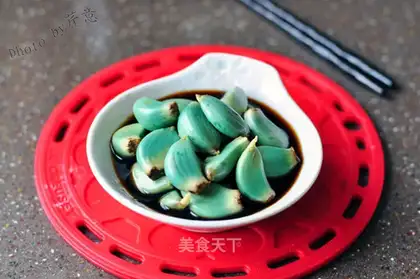
Laba garlic is a custom of pickling garlic on the eighth day of the twelfth lunar month, popular in northern China, especially in the North China region. The ingredients are simply vinegar and garlic cloves.
Picking Laba garlic is a traditional snack, mainly popular in northern China, especially in the North China region, as a festive custom for the Laba Festival. Garlic is pickled on the eighth day of the twelfth lunar month. The ingredients are very simple: just vinegar and garlic cloves. The method is also extremely simple: place the peeled garlic cloves in a sealable container like a jar or bottle, then pour in vinegar, seal it, and place it in a cool place. Slowly, the garlic soaked in vinegar will turn green and eventually become a vibrant jade green, like jadeite. In northern China, as soon as the eighth day of the twelfth lunar month arrives, the atmosphere of the New Year grows stronger day by day. In most of the North China region, there is a custom of pickling garlic in vinegar on this day, called Laba garlic.
Laba Noodles
Laba Vinegar
Laba vinegar is a traditional custom of the Laba Festival. In northern China, there is a custom of pickling garlic in vinegar on this day, named "Laba vinegar". Laba vinegar needs to be soaked until the first day of the lunar new year. On that day, when eating dumplings, one eats vegetarian dumplings, symbolizing a pure and clean year for the whole year. Dipping them in Laba vinegar has a special flavor. "Laba vinegar" is not only mellow in taste but also does not spoil for a long time.
Laba Noodles
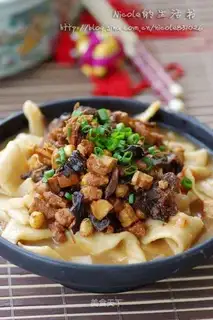
Laba noodles are the seasonal food for the Laba Festival. This traditional noodle dish is popular in the Guanzhong region of Shaanxi Province. In the Chengcheng area of the Weinan region in northern Shaanxi, people generally do not eat porridge on the Laba Festival. Every morning on the eighth day of the twelfth lunar month, every household eats a bowl of Laba noodles.
Using noodles and various beans (with red beans as the main ingredient) as raw materials, the noodles need to be prepared as "jiuye noodles" (noodles as wide as a chive leaf). The red beans are soaked overnight and used to make a soup on Laba day. After the water boils, turn to low heat until the red beans are thoroughly cooked, then cook the noodles over medium heat. At the same time, sauté chopped scallions in hot oil. Once the noodles are cooked, pour the scallion oil into the pot.
Related Reading: What to eat for the Laba Festival?
Different regions have different Laba customs
1. Customs of Laba Festival in Xining
In Xining, people do not eat porridge on Laba Festival, but rather wheat kernel rice. On the evening of the seventh day of the twelfth lunar month, freshly milled wheat kernels are cooked with beef and mutton, along with seasonings like green salt, ginger peel, Sichuan pepper, cardamom, and fennel. After being simmered over a low fire all night, the wheat kernel rice has a wonderful aroma and is very delicious.
2. Customs of Laba Festival in Jiangsu and Zhejiang
Jiangsu people eat both sweet and savory Laba porridge. Ingredients for the porridge include arrowhead, water chestnut, walnut kernels, pine nuts, fox nut, red dates, chestnuts, wood ear mushrooms, green vegetables, and enoki mushrooms. If making a savory porridge, green vegetables and oil are added.
Zhejiang people generally make Laba porridge with walnut kernels, pine nuts, lotus seeds, red dates, longan pulp, and lychee pulp, which is fragrant and sweet. It is said that this method of making porridge was spread from Nanjing.
Laba Cai
3. Customs of Laba Festival in Shaanxi
After the Laba porridge is cooked, it is first offered to the gods and ancestors. Then, it is given to relatives and friends, and it must be delivered before noon. Finally, the family eats it themselves. Any leftover Laba porridge, if kept for a few days and still remains, is considered a good omen, symbolizing "having a surplus year after year". If the porridge is given to the poor, it is a way to accumulate good karma. In places where rice is not grown or is scarce, people do not eat Laba porridge but Laba noodles. They make a "saozi" (a topping) from various fruits and vegetables, and roll out the noodles. On the morning of the eighth day of the twelfth lunar month, the whole family eats together.
4. Customs of Laba Festival in Gansu
The traditional way of making Laba porridge in Gansu uses grains and vegetables. After cooking, it is eaten by the family and also shared with neighbors and used to feed livestock. The Wuwei area of Gansu observes a "Vegetarian Laba", eating thick rice porridge, lentil porridge, or congee, which is served with fried "sanzi" (fried dough twists) and "mahua" (fried dough knots). This is commonly called "lentil porridge with sanzi".
Related Reading: What to eat for the Laba Festival?
5. Customs of Laba Festival in Beijing
The Laba porridge in Beijing can be said to be the most elaborate. Many ingredients are mixed with the white rice, such as red dates, lotus seeds, walnuts, chestnuts, almonds, pine nuts, longan, grapes, ginkgo nuts, candied citron peel, rose petals, red beans, peanuts... no less than 20 kinds. People start washing the rice, soaking the fruits, peeling, and pitting on the evening of the seventh day of the twelfth lunar month. They begin to simmer it over a low fire at midnight, and it's not until the early morning of the next day that the Laba porridge is considered fully cooked.
6. Customs of Laba Festival in Northwest China
On the Loess Plateau in northern Shaanxi, when making the porridge, in addition to various grains and beans, various dried fruits, tofu, and meat are also mixed in. After eating, the porridge is also smeared on doors, stoves, and trees outside the door to ward off evil and disaster, and to welcome a bountiful harvest for the coming year. Moreover, eating vegetables is taboo on Laba Day. If vegetables are eaten, there will be many weeds in the fields. On this day, besides eating Laba porridge, people also offer the porridge to their ancestors and the grain granary.
Laba Garlic
7. Customs of Laba Festival in Ningxia
Labafan (Laba meal) is generally made by cooking various beans with rice and potatoes, and then adding "maisui zi" (wheat or buckwheat cut into diamond or willow-leaf shapes) or "queer tou" (small round dumplings made from dough). Before serving, scallion oil is added. Like in northern Shaanxi, the whole family only eats Labafan on this day and no vegetables.
You may also like:
How many days should Laba garlic be pickled for the best taste?
A bowl of Laba porridge for peace and prosperity year after year
What ingredients should be included in Laba porridge?
Eating Laba garlic often in winter can kill bacteria and prevent colds
 It's a gang
 It's not worth it
 Help
Help