Introduction: Known as the "Eastern Miracle Fruit," goji berries are well-known for their health benefits. Ningxia goji berries are the most famous, but do you know how to select and properly consume them?
Goji Pork Stomach Soup
Five ways to choose good goji berries:
Look. Good goji berries are dark red but not overly vibrant, with uniform size, not moist, and without black tips. Ningxia goji berries are typically spindle-shaped with a natural white dot at the tip.
Squeeze. Good goji berries are not sticky in hand and do not form obvious clumps. If they feel astringent, it indicates poor quality.
Soak. Good goji berries are usually plump. After soaking, most Ningxia goji berries will float to the surface.
Smell. Unscrupulous merchants often fumigate goji berries with sulfur to achieve a bright color. Fumigated goji berries often have a distinct sour or pungent smell. Truly good goji berries have their unique, characteristic flavor.
Taste. Ningxia goji berries are sweet but not cloying, slightly sour, with a slightly astringent and bitter aftertaste.
Goji Black Bean Porridge
After selecting good goji berries, you need to know the correct way to eat them.
1. Do not consume excessively
Many animal experiments on the toxicity of goji berries have proven that they are a very safe food, containing no toxins and can be consumed long-term. However, as with any health supplement, goji berries should not be consumed in excess. Generally, it's appropriate for healthy adults to eat about 20 grams of goji berries per day. If you want therapeutic effects, about 30 grams per day is best.
Snow Ear and Goji Pear Soup
2. Chewing them directly is more effective
When you steep goji berries in water or use them in soups, their medicinal properties are not fully released. Due to factors like water temperature and soaking time, only some of the active ingredients are released into the water or soup. Chewing them directly allows for more complete absorption of nutrients and better utilization of their health benefits. However, when chewing goji berries, it's best to halve the quantity to avoid excessive supplementation.
Honey, Jujube, and Goji Tea
3. Who is best suited to eat goji berries
Goji berries are most suitable for people with a weak constitution and poor immunity. Moreover, one must persist in consuming them daily to see effects. Those with a weak spleen and stomach, cold-dampness, or diarrhea; and those with external heat pathogens should not eat goji berries, as it would be like adding fuel to the fire. Goji berries have a strong warming effect on the body, so people with colds, fevers, inflammation, or diarrhea should avoid them.
Goji, Honey, and Pomelo Tea
4. Goji berries can be consumed year-round
Goji tea has effects such as reducing fever, treating diabetes, and relieving coughs and phlegm. Additionally, goji tea is also beneficial for treating a cold constitution, frigidity, indigestion, liver and kidney diseases, tuberculosis, constipation, insomnia, low blood pressure, anemia, various eye diseases, hair loss, stomatitis, and skin care. The medicinal effects of goji tea are very extensive, and long-term consumption of goji berries or drinking goji tea has no side effects.
Goji, Chinese Yam, and Pork Rib Soup
 Stewed fragrant pear with Chinese wolfberry with snow ears
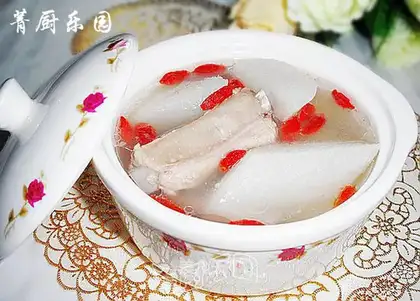 wolfberry, yam and pork ribs soup
 wolfberry and black bean porridge
 Honey-tree tea
 Pork belly soup
 A tea with honey bee