Introduction: Cancer prevention and treatment are the mainstays of various health posts, and "vegetables preventing cancer" is a particularly popular topic. Some "popular science articles" even detail the anti-cancer mechanisms of various vegetables, filled with a dazzling array of technical terms that are hard not to believe. Are vegetables really that magical?
Eating more vegetables is indeed beneficial for cancer prevention and treatment.
Vegetables are rich in vitamins, minerals, fiber, and various biologically active phytochemicals. Eating more vegetables is indeed beneficial for cancer prevention and treatment. The American Cancer Society's "Nutrition and Physical Activity Guidelines for Cancer Survivors," published in 2012, states: "Eating a diet rich in vegetables and fruits may help reduce the risk of some cancers, lower the risk of cancer recurrence, and improve survival." However, it also states: "It is not yet clear which specific components in fruits and vegetables are most protective for cancer patients," and there is no definitive evidence that any specific vegetable can prevent the occurrence of certain cancers.
Therefore, the "Guidelines" do not recommend any single vegetable or a few specific ones, but suggest that people consume a variety of colorful vegetables and fruits daily. For cancer patients, the "Guidelines" also encourage them to drink at least 2-3 cups of vegetable juice and 1.5-2 cups of fruit juice (of any kind) every day.
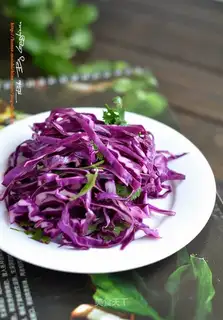
Cold Slaw with Purple Cabbage
Vegetables are not a cancer killer.
Since no specific vegetable is a cancer killer and the anti-cancer mechanisms of vegetables are not yet clear, what about the many widely circulated and assertive posts?
For example, one post says like this: "Sulforaphane and other compounds found in cruciferous vegetables like cauliflower and broccoli can induce the production of detoxifying enzymes in the body. Regular consumption can prevent the occurrence of stomach, lung, and esophageal cancers."
The seemingly scientific terminology, the clear mechanism, and the pleasing results are all, unfortunately, not withstand scrutiny.
Through research, we can easily learn the following: "Glucosinolates" are a general term for a group of sulfur-containing compounds in cruciferous plants. When plant tissue is damaged, they can produce a pungent smell through chemical reactions to defend against fungi, insects, etc. Their hydrolysis product, "isothiocyanates," has been found to reduce carcinogenic intermediates and inhibit tumor formation.
Cold Broccoli Salad
The problem seems to be solved. Isn't this scientific proof that "cauliflower prevents cancer"?
As the saying goes, "It's irresponsible to talk about pharmacology without considering the dosage." Related research indicates that to achieve anti-cancer activity in the human body, the intake of "isothiocyanates" should be at least 200-400mg. How much cauliflower would that require?
The answer is: it's impossible to get enough. According to calculations, every 100g of cauliflower contains about 11.7-78.6mg of "glucosinolates." After cooking, the average loss rate is 36%, and the content of the anti-cancer component "isothiocyanates" is almost zero after cooking.
In fact, current evidence on the anti-cancer effects of "isothiocyanates" and cruciferous vegetables basically comes from cell and animal experiments. In these experiments, the doses of the compounds used are far, far beyond the normal levels found in people's diets. Therefore, the "isothiocyanates prevent cancer" conclusion drawn in the lab cannot be directly translated into the "eating cauliflower prevents cancer" conclusion. Moreover, there is still controversy about the anti-cancer effects of this compound itself.
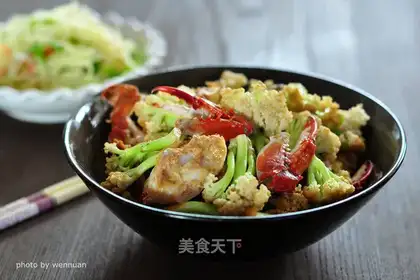
Stir-fried Cauliflower with Swimming Crab
Everyone has heard the story of "The Foolish Old Man Who Moved Mountains." The Foolish Old Man led his children and grandchildren to break rocks and soil, planning to flatten the Taihang and Wangwu mountains, and believed: "My children and grandchildren are endless, but the mountains will not grow, so why can't we flatten them?" This reasoning sounds good, but it is not practically feasible. If not for a deity's intervention, the result would surely be "with his remaining strength in his declining years, he could not even damage a single hair of the mountain."
Similarly, eating a few bites of cauliflower and ingesting a tiny amount of a substance that is theoretically good for cancer prevention is, for a tumor, also "could not damage even a single hair of the cancer."
Regarding "vegetables preventing cancer," we can summarize it like this: Consuming a wide variety of vegetables daily is indeed beneficial for cancer prevention and treatment, the mechanism is not yet clear, and no specific vegetable has been definitively proven to prevent certain cancers. In conclusion, we should encourage everyone to eat more vegetables, and let science, not rumors, guide our dining tables.
Cold Slaw with Purple Cabbage
 Honey crispy chicken steak
 Creamed blue
 Peaches
 Family meal