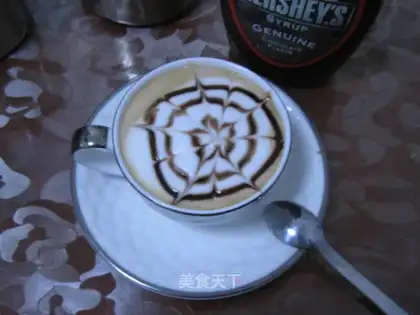
Capuccino is an Italian coffee mixed with the same amount of Italian espresso and steam foam milk. The colour of coffee at this time, like the presence of a turban on a dark brown coat by a monk of the Capuchino Church, is famous. Traditional cappuccino coffee is one third condensed coffee, one third steam milk and one third foam milk. High-strength coffee, rich in tulips, with lubricated bubbles; there are a few condensations. With the smell of Italian coffee from the bottom up, the coffeeers are so moved. It has a unique and irresistible charisma, which at first smells delicious, and at the first tastes sweet and soft with a lot of cream, at the second tastes the bitterness of the coffee beans, and at the end of the day, when the tastes remain in your mouth, you feel like you have an extra salsin and an extra salud. Don't you think it's amazing that a coffee can taste different and unique tastes? The first taste of bitterness always tastes like sour, and a lot of bubbles are like young people's light lives, and the bursting of bubbles and a little bit of bitterness are like a conflict between dreams and reality. Finally, after a taste of life's sadness, life's fragrance is intoxicated。
As the concept of a healthy diet moves deeper into the heart, soybean mills become essential appliances for many household nutrition breakfasts. But a single soybean taste has also made it difficult for many mothers, and the first cacao soy machine, as leader of the soybean grinder, has revolutionized soybean soybean. Through a more scientific process of grinding and cooking, cocoa's sense of silk sliding and soybean nutrients, it has brought a new taste of laces on the tip of the tongue. 100 per cent of raw milling, 100 per cent of beans and cocoa are released, and you can't stop. Coco, it's silky, it makes you forget about the world of cocoa. This time, there were no cocoa beans in the house and coffee beans were used to boil non-beans. And when you cook soy, you can really describe it as a "house full of fragrances" that makes coffee in peace days that is more similar than that, except for a strong soybeans。
Coffee originated in the tropics and the world ' s first coffee tree was found in the Horn of Africa, now Ethiopia. The local indigenous tribes often grind the fruit of coffee and then rub it with animal fat and make ballballs, which are considered by the local people to be the most precious foods to be used exclusively by the warriors on the battlefield. I think it's using coffee to awaken the brain. Only people didn't know. The first time in the world that coffee fruit was dried up and boiled was for Arabs, who were now the first to drink it, except that the Arabs at the time used it as a medicine for digestion, and then slowly discovered that it was more brain-aware and that, because the Islamic sect strictly prohibited drinking alcohol, coffee was used as a substitute for alcohol, which was often used as an anointed, stimulating drink. To date, people of certain nomadic Islamic peoples in the Middle East region have had to cook a coffee beans with hand-made copper canteens to digest the greasyness of the sheep after eating in the cold spot on Gobi Beach. That was a nice scene. It was only after the fifteenth century that coffee spread to Egypt, Syria, Iran and Turkey. As a result of Turkey’s early war on the European mainland, many soldiers in the army, including generals, had a habit of drinking coffee and had been stationed for many years, leaving behind a great deal of goods, including coffee beans, from which the Viennaians and the French had learned the skills and experience of making coffee drinks from Turks, which, after many years of popularization, by the sixteenth century Europeans had integrated into their lives into customs and diets. A perfect culture of coffee with European tone has evolved. It was later disseminated by European missionaries that coffee was able to travel around the world. Although today's larger coffee plantations have brought great economic gains to their country, such as the booming lands of India, Brazil, Cuba, Viet Nam, Taiwan and Hainan. But the history of those places that were once colonized cannot be erased. The current economic gains were the result of colonization. Maybe I'm wrong, but it's connected. Let's not comment on history. Let's talk about coffee. Although there are many types and tastes of coffee, such as blue mountain tastes (not much because they produce 40,000 bags a year), high mountain tastes, Sumatra Mantnin tastes, Mocha tastes, Cuban Crystal Mountain, Kenyaa, etc. However, the practice is rich in Italian coffee, which is also representative of European coffee. They include Espresso, Kabushinolatte and Machido. The practice is also sophisticated: in Italy, most Italians do two things every morning on their own stove, one milk and one coffee. What has to be said about Italian coffee is espresso, which is extracted using Italian-made steam-coffee machines, a good coffee machine at a price that I can't reach. My consumer consciousness is that I don't have the free money to make up the fence, and it is rarely used in Italian homes. They use steam mochapots, which are cheap. I have one, which is of national origin, which is good. It's the same principle. If you want to make some bouquets, you're going to have to buy milking, raffle cups, coffee mills, and your favorite coffee beans. There's a lot of demand in making fancy coffee, Grandma Cow. It's best for a Nestle full milk, for Starbucks, and there's hardly any market for anything but Internet. We did not buy it, nor did the poor farmers believe in evil, so I used to take pure milk from Eli, and I could strike it out. Here's my coffeemaker. It's been fun with me for over four years。