Bamboo
By VicentaLakin
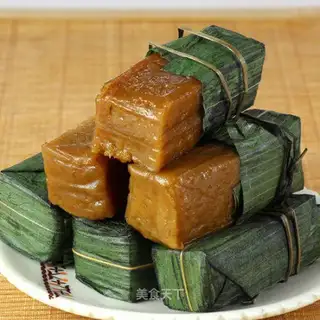
It is the traditional specialty food in the South China Sea, which is the country's most beautiful tourist destination. It is made of rice, accompanied by red sugar, fresh pork from the farm, bamboo water, and made of pure handmade detail. The colours are red and sweet and suitable for all ages. It's for breakfast, snacks, snacks. It is easy to eat, to heat up, to travel home and to give good things to relatives and friends. Nutrient ingredients such as vitamins, chlorophyll and cellulose in bamboo loaf cakes are produced, coloured and natural aroma are produced。
Recipe Recommendations
- pork belly
- fragrant rice
- Zhugenshui
- glutinous rice
- brown sugar 2 parts
- sesame 1 part
Steps for Bamboo
1
Plutonium and rice or rice are washed and placed in containers, mixed with yellow sugar and bamboo water, boiled for two to four hours, cooled to constant temperature and divided into small pieces。2
When the fat flower is washed, stripped, mixed with the purified sesame and divided into small pieces, a fat pork, etc., is placed in a mixture of evaporated rice and fragrance。3
Before bamboo leaves are used, it is advisable to boil them with water for three to five minutes, and when the leaves are cooked, they are quickly put into cold water to prevent the colour of the leaves from turning yellow。4
They are then packaged, bundled and put in a steam cage for four to five hours, at a temperature of 100 ~ 120°C, after natural cooling。Bamboo Make Tips
[Notes] 1. Try to choose meat with an even distribution of fat and lean meat; the texture will be better. 2. Before using bamboo leaves, it is best to boil them in water for 3-5 minutes; this sterilizes them and increases their flexibility. 3. After boiling the bamboo leaves, quickly place them in cold water to prevent them from turning yellow. 4. Glutinous rice is also known as Jiangmi. Jiangmi is the name used by Southerners for glutinous rice. During festivals and holidays, eating glutinous rice meat cake enhances the festive atmosphere. Try to select glutinous rice produced in the north. 5. If you cannot shape it well by hand, you can line the bottom with lotus leaves, reed leaves, or bamboo leaves, then spread a layer of glutinous rice and meat, and cover it with another layer of leaves. Steam, let cool, cut into portions, and arrange on a plate. Once skilled, you can shape it into squares, rectangles, triangles, and various other shapes. 6. Traditional glutinous rice cakes usually involve mixing glutinous rice with meat filling, wrapping it in glutinous rice flour dough, and deep-frying it in oil. However, as people now avoid greasy food, it has been changed to steaming. 7. Pork belly can be marinated beforehand according to personal preference with shredded green onion, minced ginger, sesame oil, soy sauce, MSG, and salt.
[Health Benefits of Glutinous Rice] Traditional Chinese Medicine believes that it tastes sweet and has a warm nature. It can nourish the body's vital energy. After eating it, one feels warm all over, which helps to resist cold and provide nourishment, making it most suitable for consumption in winter. The main function of glutinous rice is to warm and tonify the spleen and stomach. Therefore, people with spleen and stomach qi deficiency or frequent diarrhea can achieve good therapeutic results by eating it. It can also alleviate symptoms caused by qi deficiency, such as night sweats, sagging and distension in the waist and abdomen after pregnancy, and shortness of breath and fatigue after physical labor. The TCM classic "Ben Cao Jing Shu Lun" provides a full explanation of the health benefits of glutinous rice, stating that glutinous rice is "a grain that tonifies the spleen and stomach and benefits lung qi. When the spleen and stomach benefit, the center (referring to the human stomach) naturally becomes warm, and strength becomes firm; warmth can nourish qi, and when qi flows smoothly, the body naturally generates heat. It is suitable for those with deficiency and cold in the spleen and lungs."