Salt meat
By VicentaLakin

Today is the midday festival of the Chinese people, which is one of the traditional practices of the Chinese people. The sting, also known as the horn, the drum. It's been long and varied. In the mornings of the festival, the family eats a sap, usually the day before it is packed, cooked at night and eaten in the morning. The midday festival is held at the beginning of May of each year. As recorded in The Year of Jae-chul, the first mid-summer day of May is the day of the sun, so it was also called the Day of the Sun at the beginning of May. In addition, the festivals are called “Noon's Day, May's Day, Dragon's Ark Festival, Bathland Festival”. The festival is a traditional cultural festival that is popular in China and in Chinese culture. The festival began in China and began with a totem festival for the clans worshiping the Dragon Totem in the ancient Bong region (central and downstream Yangtze and south of the Yangtze region), with the practice of holding tribal totem offerings in the form of a canoe competition at the beginning of May. After that day, the poet of Chu was stoned. The Rojiang self-destructed, and the ruler used midday as a holiday in commemoration of Tuwon. According to the Story, “Jasheng Quantuan” is the Minister of King Chuhuai during the spring and autumn. He advocated for good deeds, for the strong soldiers of rich nations, for the resistance of the Qin, and against the strong opposition of the noble Qin. He was removed from his post, driven out of the capital and exiled into the valleys. In exile, he wrote the Invincible poems, such as "Lift, Heavenly Question, Nine Songs", which are unique and far-reaching (thus also known as Poetry Day). In 278 B.C., the Qin army attacked the capital of Chu. Having seen his country invaded, his heart was cut, but he refused to abandon it. On 5 May, after writing the final writing of " Wisha " , he died and wrote a magnificent patriotic instrument in his own life. After the death of Tsuohara, the people of Chu suffered a great deal of grief and fled to the border of the Yangtze River in order to hang themselves. The fisherman boarded up a boat and came up to recover his body. One fisherman threw food such as rice, eggs, etc., which he had prepared, “pounced, pounced” into the river, saying that he would not bite the doctor's body if he had eaten enough. People are following suit. An old doctor poured a bottle of wine into the river, saying that he was going to take the medicine to get rid of Dr. Kuo. Then, fearing that the rice pack would be eaten by the dragons, people came up with the leaves of the trees, which were wrapped in silks, and developed into sorghums. Then, at the beginning of May of each year, there was the practice of the dragon canoe, of fertilizing and drinking wine, in honour of the patriot poet. To this day, the name of Kuohara has been extended to all parts of China. In some parts of the country, there are also accounts of the memory of Suzuko and Cao Tao. At noon, four traditional festivals were celebrated, including Spring Festival, Ching Myung Festival and Mid-Autumn Festival, also known as the Chinese Han. Since ancient times, there have been festivals such as a canoe and a canteen. Since 2008, the festival has been classified as a national holiday. In May 2006, the State Council included it in the first national list of intangible cultural heritage; in September 2009, UNESCO formally considered and approved the inclusion of China ' s non-material cultural heritage at the end of the day, making it China ' s first optional world non-material holiday. It has become a common practice for the people of the country to eat sorghums, to drink gin, and to drink wine. They are mainly made of green reed leaves or leaf leaves produced by the pond. The leaf, popularly known as the leaf, grows in vast mountains with well-established roots and strong vitality, not only as a good soil and water to protect the vegetation, but also as an inexhaustible asset, a “green bank” for the people of the mountains. It can be used not only for packs, but also for the packaging of other foods and table decorations and the matching of foods, but also for the preparation of vessels, the preparation of lunch boxes and the cutting of various shapes. The leaf is naturally grown, free of any poisoning or contamination, and is available year by year, quarterly, packaged as food, with a “one-off” free of pollution and use. Thus, what today's nutritionists call “natural green food”. Leaf extracts are rich in nearly 40 functional factors, such as sugar folate, acetone, organic zinc, selenium, iodine, calcium, magnesium, iron, multiple vitamins and amino acid. It has long been documented in this Basics that the leaves have the effect of accommodating the bleeding, decontaminating the swelling, curing the vomiting of blood, bleeding, bad piss and swelling. These effects are also described in the Great Chinese Medicine Dictionary. In recent years, studies have shown that sugar is also resistant to cancer. The traditional form of tungstens is a triangle, usually named after the inner tungsten, which is called rice, which is mixed with soybeans, which is known as date palms, and which is commonly known as rice. The date tune is “morning”, so the child who eats the date eats the most, so that the child who is supposed to read can eat the mid-morning. In the past, students had to eat dates in the morning, and in the mornings of the secondary and university entrance examinations, parents had to make dates for candidates. The salted meat is a famous Han snack in Gangnam. I packed this salted meat today because it was the first time, and it wasn't very good, but it tasted so bad, it tasted really good. If you like meat and you like salty tarts, you can try it
Recipe Recommendations
- eucalyptus leaves 1 handful
- glutinous rice 1000 grams
- baking soda 10 grams
- pork belly 400 grams
- salt 12 grams
- cooking wine 2 tablespoons
- soy sauce 3 tablespoons
- soy sauce 1 tablespoon
- oyster sauce 1 tablespoon
- black pepper half a teaspoon
- spiced powder half a teaspoon
- cotton thread appropriate amount
- salty and fresh
- cook
- three-quarters of an hour
- ordinary
Steps for Salt meat
1
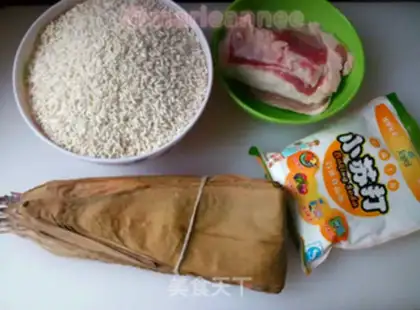
Preparation of food: rice, decorated bouquets, leaf, soda
2
We'll wash it twice, we'll wash it out, we'll re-integrate it over 3 cm and we'll soak it all night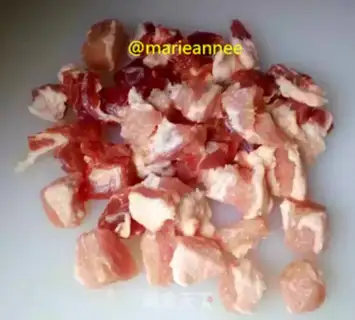
3
Five flowers cut small pieces
4
Cut-off broths are placed in the container, and the spices are added (all but water and cotton lines are added to the supplement, only 2 grams of salt is placed)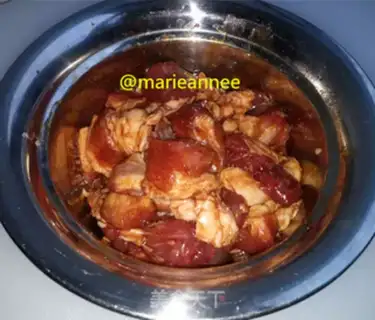
5
I'll pick it up one night before it's too late. Production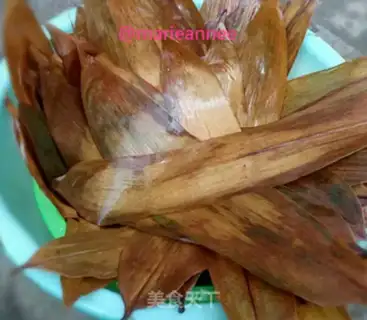
6
The leaves were brushed with a little brush and boiled in the water for five minutes
7
The salty rice is ready for use
8
Little Soda in the bowl. A little water melted into soda
9
Reload the dried rice into the blisters with soda and 10 grams of salt
10
Smash and rest till half an hour
11
Take a leaf in a conic form (relatively narrow leaves with two overlaps and a slight staggering in order to increase the width of the leaf) and be careful that the tip is closed to prevent leakage of rice。
12
Put a spoonful of rice in a cone-like drum with a small spoon and stick a bucket with a chopstick, so that the grain inside the leaf is tighter
13
Add a piece of salted meat
14
Put another layer of rice on it。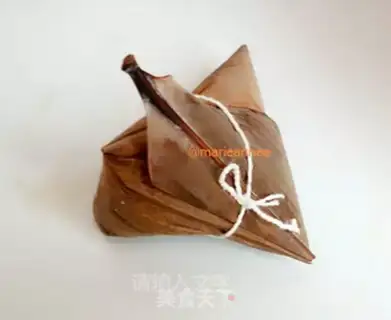
15
Holds the cone in the mouth of his left hand, flattens the upper finger with his right hand, then folds the extra leaf down and wraps the rice, then crushes both sides of the leaf with his hand, then folds the tail of the leaf to the side, then ties it to the cotton line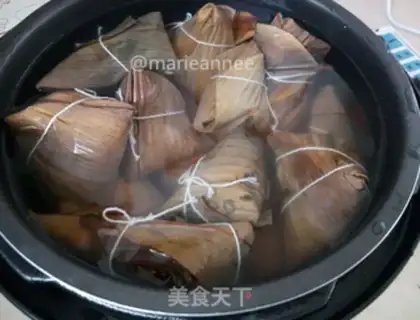
16
Packed spasms into electric high-voltage pans, water in parallel to the stupor, or perm
17
Put the lid on, and then press the spasm key (the system automatically displays 40 minutes) to boil, and when you hear the high-pressure pot sound "drops" indicate that the time has arrived and the tweed is ready. You can cut the power, you can keep the cap open in half an hour, and you can wait a few hours until it cools
18
You can't eat it if it's coldSalt meat Make Tips
1. THE RICE MUST BE BLOATED IN ADVANCE FOR ABOUT 10 HOURS; 2. THE MEAT MUST BE MADE EARLY, WITH A MINIMUM OF TWO HOURS OF PICKLED UP, AND IF YOU LIKE TO EAT IT, YOU CAN HAVE A FEW EXTRA PIECES OF MEAT IN EACH OF THE STUBBLES; 3. THE TWIG IN THE LEAVES CAN BE INSERTED INTO A SPOON OF RICE, WITH A LITTLE PRESSURE, SO THAT THE TWIGS CAN BE WRAPPED UP IN A LITTLE BIT, SO THAT IT LOOKS GOOD; 4. THE WELL-PREPARED STUBBLE CAN BE KEPT IN THE FREEZER AT A TIME AND HEAT IT IN THE STEAM PAN, AND CAN BE BOILED IN TWO POTS IF IT IS COOKED WITH A NORMAL BOILER, WITH AN APPROPRIATE EXTENSION OF THE TIME; 5. THE TWIG WRAP CAN GROW BROWN, FOUR-ANGED PALMS, TRIANGLES, TANGOU, CONES, ETC., AND THE KEY IS NOT EXPOSED RICE; 6. HIGH-PRESSED POTS CAN BE FILLED WITH WATER, BUT TWO POTS CAN BE BOILED IF IT DOES NOT BOIL. I'VE GOT 24 CROTCH IN 1,000 GRAMS AND I'M JUST COOKING A POT. 7. THE MAIN RAW MATERIAL OF THE STUN IS RICE, WHICH, FROM A CHINESE MEDICAL POINT OF VIEW, TASTES HOT AND HAS THE EFFECT OF WARMING THE STOMACH WITH A HEALTHY SPLEEN. IN THIS DRAFT, IT IS STATED THAT THE RICE CAN “PRECIPITATE ITS STOMACH, COOL ITS DIARRHEA, REDUCE ITS DEFECATION, SWEAT ITSELF, AND HAVE A POX”. AFTER MAN ' S SEEDING, THE PROBLEM CAN BE IMPROVED BY INCREASING HEAT, INCREASING BLOOD FLOW ON THE BODY ' S SURFACE, DECREASING GASTROINTESTINAL FUNCTION, AND PEOPLE ARE PRONE TO THINNING IN THE SUMMER. 8. GLYCOL CONTAINS HIGH-QUALITY STARCH AND B VITAMINS, UNSATURATED FATTY ACID, CELLULOSE, ETC. HOWEVER, IT CONTAINS FEWER PROTEINS AND IS VERY SHORT OF LYSINE, CHROMIUM ACID, VITAMIN A, VITAMIN C AND VITAMIN D, WITH HIGH CALCIUM LEVELS THAT ARE NOT EASILY ABSORBED BY HUMANS. AS A RESULT, THE BAGGING OF RICE IS MADE INTO A SAP AND FED TO AVOID INCOMPLETE NUTRITION. THE BODY IS NATURALLY HEALTHY AND NUTRITIONALLY COMPREHENSIVE, BUT BECAUSE OF ITS HIGH HEAT, AND BECAUSE OF ITS HIGH VISCOSITY AND INDIGESTION, THE ELDERLY, CHILDREN AND PEOPLE WITH POOR DIGESTIVE FUNCTIONS ARE NOT ALLOWED TO EAT IN ORDER TO AFFECT THEIR STOMACHS AND NORMAL DIETS; AND PERSONS WITH CARDIOVASCULAR DISEASES, THE “THREE-HIGH” POPULATION, DIABETES, AND GASTROINTESTINAL DISEASES ARE CAREFULLY FED OR EVEN FASTED. EVEN A MAN WITH A HEALTHY STOMACH CANNOT EAT A STUPOR IN THE EARLY MORNING OR TWO HOURS BEFORE SLEEPING AT NIGHT, OTHERWISE IT IS TOO LONG IN THE STOMACH TO DIGEST, AND SHOULD AS MUCH AS POSSIBLE BE EATEN AT NOON AND AFTERNOON, AND ONLY ONE OR TWO AT A TIME, IN ACCORDANCE WITH THE PRINCIPLE OF “LESS MEALS”. CONCOMITANTLY WITH STINGING, VEGETABLES AND FRUITS CAN INCREASE THE INTAKE OF FIBRES, HELP INTESTINES, GASTRIC CREEPS AND AVOID SYMPTOMS SUCH AS ABDOMINAL SWELLING AND DIARRHOEA CAUSED BY STINGING. THIS COMBINATION OF DIETS IS NOT ONLY NUTRITIONALLY BALANCED, BUT ALSO PROVIDES FOR AN EASY, STOMACH-FREE MIDDAY FESTIVAL。