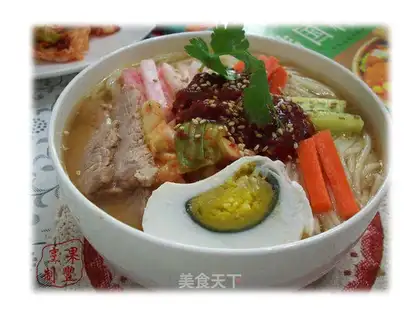
A bowl of cool and refreshing cold noodles is really a kind of enjoyment! I think the main feature of Korean cold noodles is the materials used to process cold noodles. They use buckwheat flour and starch, as well as corn flour, sorghum rice flour and soybean starch. Then there is cold noodle soup, add beef soup or chicken soup, and then add some peppers, beef slices, eggs, apple slices, sesame oil and other seasonings on the noodles. The combination of the two is cool, fragrant, sweet and fresh.
As for what is authentic? Hehe ~ I think due to the problem of place of residence, it is somewhat similar. It does not have to be the same raw materials. Everything that can reflect its national characteristics will be enough. In fact, cold noodles are one of the home-cooked dishes of the Korean compatriots. The auxiliary materials used, such as kimchi, are only small dishes regularly available at home. Therefore, in addition to the processing methods of noodles and the blending of soup, these auxiliary materials should be arbitrary.
Today, I dare not say which region's style I make represents, but mainly suits my own taste and is good as long as it is delicious. At the same time, I also recommend that friends who are about to try making cold noodles. Although they don't have regular pickles and hot sauce at home, these ingredients can be easily purchased in the supermarket, which can help you get twice the result with half the effort!
North Korea cold noodles
By DougLittel
Recipe Recommendations
- noodles 350 grams荞麦面和淀粉按4︰1比例)
- beef 200 grams
- white sugar 1 tsp
- refined salt appropriate amount
- MSG appropriate amount
- onion 1 piece
- Jiang 3 tablets
- carrots 1/4 of
- cucumber 1/4 of
- cabbage appropriate amount
- cooked eggs half a
- chili sauce 2 tablespoons
- chili noodles 2 tsp
- diced green onion 3 tablespoons
- garlic 1 tsp
- sesame 1 tsp
- sesame oil appropriate amount
Steps for North Korea cold noodles
1
Cooking soup: Wash a piece of beef, cut it into large pieces, blanch it with boiling water to change color, and remove it. Wash the pan and add water again, add beef, spring onion, ginger slices, and soy sauce, and simmer slowly for 1 hour over medium heat. Filter the beef soup, place it in a container to cool, add sugar, white vinegar, monosodium glutamate, and refined salt. Make it sour, sweet, salty and fresh moderate. Then it is best to put it in the refrigerator to cool for later use. Separately slice the cooked beef and set aside. Accessories: Cut small radish kimchi into 5 cm long strips, and cut cabbage and kimchi into strips. Boil carrots whole and cut into thin strips, as is cucumbers. Use enough water to boil the noodles (the ones bought in the market are usually soaked first and then scalded, please consult the merchant when purchasing), then cool it repeatedly with cold water, and remove it. Mix the seasoning and chili sauce. Use a bowl to hold the noodles, add the kimchi trimmings, beef slices, and eggs, then add the cold noodle soup, and then stir in the seasoning and spicy sauce.2
Practice of cabbage and kimchi: Raw materials: 500 grams of Chinese cabbage or cabbage, 1 onion, 1 orange, 5 grams of garlic, 2 red peppers, 2 grams of ginger, and appropriate amount of chili noodles. Seasonings: 2 grams of monosodium glutamate, 5 grams of white sugar, 3 grams of salt. Practice: 1) Cut cabbage or cabbage into 4 portions, and chop other raw materials into minced settings;2) Put half a can of purified water in a sealed jar, put a proper amount of salt in the water, add the cut vegetables, seal and soak for 2 to 3 days;3) Remove the marinated vegetables, rinse with cold boiling water, drain the water, stir the seasonings and other cut raw materials into a paste, and spread them evenly on the vegetables.3
Practice of radish kimchi: Raw materials: 300 grams of white radish, 300 grams of carrot, 10 grams of ginger and garlic each, and 20 grams of pepper. Seasonings: 10g salt, 2g monosodium glutamate, 20g white vinegar, a little white sugar. Practice: 1) Wash and slice radish or strips, wash and slice ginger, peel and wash garlic, and wash peppers. 2) Put the chopped radish slices into a bowl, add ginger slices, garlic grains, add salt, monosodium glutamate, white vinegar, and white sugar, mix well. 3) Transfer the seasoned radish slices into a bowl, add cold boiled water until they are covered, and seal and marinate for 2 days.