Spaghetti
By VicentaLakin
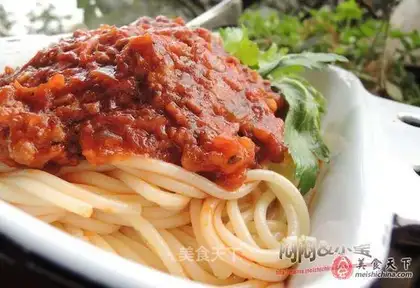
it's the new pasta. it's delicious. a recipe had previously been issued, and because of the small size of the picture, many steps had not been taken, and there was no beef soup, which tasted like a different grade. it's so good this time, you think you can salivate, and you can go home at night with cheese, and it's gonna be so good and old that when you've never had meat sauce before, you think it's a strange face. until one time, after someone else had tasted the meat sauce, he fell in love with the italian food. and then i looked at a lot of posts on the internet, and i've tested them a number of times (because they're good and often they like to eat), and it's quite a good taste today. it's a recipe that you've thought about because of your preferences, but there's no strict limit on the proportion of all kinds of ingredients, and you'll be able to add or reduce them as you like. if you don't like celery, you can get rid of it; but the onion must have it, it can be halved. for small dosages such as salt, sugar and vanilla, since the text is as useful as a spoon, no friend can refer to the following additional notes, either by weighing the kitchen or by looking at the eye. in general, for friends who do not have pasta, first try the formula in the text and then add or decrease certain ingredients to their preferences to make the most appropriate face for their taste. add: a small spoonful of sugar equals 4g, a small spoon of salt equals 4g, a large spoon of italian vanilla equals 2g, and a large spoon of oil i estimate is 12g。
Recipe Recommendations
- sour and salty
- fried
- an hour
- ordinary
Steps for Spaghetti
1
Figure 2-4: Add 1/2 small spoons of wine, 1/4 small spoons of salt, a pickle of garlic, blending, 20-30 minutes of pickled beef. And then you'll see that the smell of beef and the taste of wine disappears, leaving a scent of meat2
Figure 5: The salted beef pies are then added to the two keyseed oils, so that they are smoothed up until the oil is fully absorbed (this step can also be omitted, with the oil being released mainly to keep the beef too old)。3
figs 6-7: putting a proper amount of vegetableseed oil (the usual amount of fried meat in which you can see the picture, the oil is still more abundant), burning it, waiting for a slight decrease in the temperature of the oil (the stove will just open to a small medium fire) and throwing it into beef pie. we'll get the roasted meat in the bowl. ps: seed oil here can be replaced with an equal amount of butter (butter) and tasted more radiantly。4
Charts 8-9: Celery and onion in the rest of the oil, and then the rest of the garlic, and the rest of it5
Figures 10-11: When onions and celery are largely translucent, they are picked up and left in a bowl。6
figure 12-14: when the onions are finished, if the pot is already dark, you'll have to wash it and use it again, otherwise the sauce will be black and ugly. when the pot is washed, the hot pot is put inseed oil (the usual amount of cuisine) and the hot ketchup (nine layers of heat) is put in a quick dump. it was then added four small spoons of salt, beef-rich soup, and continued to fry. ps: four small spoons of salt make ketchup tastes salty and no more salt in the face, so it feels right (the population is a little heavy). a light tx can adjust salt to 2-3 small spoons。7
figure 15: tomatobut softly melted after 5-10 minutes of frying, with ketchup turning into a small fire continuing to fall. ps: it must be a small fire, it's easy to make a pot, it's easy to make a black ha. and the sauce from the fire is thicker。8
Charts 16-18: When tomato is basically turned into ketchup (about 15-20 minutes after the start), a large spoon of Italian mixed vanilla is added and it continues to boil. When tomatoes melt, they are easy to make pots, and they need constant flipping and evaporating moisture. When the ketchup becomes dryer (spreading from the bottom with a pot shovel, which can see the bottom without sauce, as shown in figure 17), it is added to the reserve meat, onions and celery that continue to boil。9
figure 19: after 5 to 10 minutes of frying, the whole sauce becomes thicker and can easily be scratched on the bottom of the pot (see figure 19), at which point the small work will be done. packagings containing meat sauce are best made of fresh bowls or glass caps, which can be easily preserved. because of the high temperature of the sauce, it's better not to use plastic. we all know the harm involved. ps: i've seen it, it's about eight. it's kind of doha because i like it. with few families, food can be cut in half before it breaks。10
this time, in order to demonstrate the weight, it is specifically called 100g. it was found that there was still a lot (see figure below) of it, like one in a restaurant outside, and some of the restaurants were estimated to have less。11
figure 21-22: the water boils and turns to a middle fire, adding one quarter of the small spoon salt in case the noodles are glued and souped into 100 g noodles。12
figure 23-24: when the noodles are softened and all sank into the water, they turn to light fire (which is critical, remember). ten minutes after cooking, noodles are swollen at this time (see figure 24) and the hard tx at food is liberated。13
figures 25-28: if you like soft food tx, pay attention. no more cooking after the fire has just ended. just cover the pan and leave the face in the water for three to five minutes. noodles recovered at this time are fully swollen (see figure 27) and, although soft, are equally flexible (see figure 25-26). after the leaching has taken place, the option is to put in a small amount of corn oil or olive oil, to prevent lasagna from being glued, or to go straight to ketchup and wait。14
if there's no spoon tx, it's not clear