Winter is cold and freezing, and many people choose to nourish their bodies during this time. So, what kind of food is suitable for replenishing the body's energy in winter? According to nutrition experts, many inexpensive "common vegetables" are very suitable for winter nourishment, with therapeutic effects for health and longevity.
Eating Chinese Cabbage Often to Ward Off Illness and Extend Life
Chinese cabbage originated in China and is the main winter vegetable in northern China. Chinese cabbage has high nutritional value, especially as it contains relatively rich vitamin C and trace element selenium, which can counteract the damage of "free radicals" to cells, thus delaying the aging process of the human body.
Braised Cabbage with Dried Shrimp
Chinese cabbage is sweet and neutral in nature. It has the effects of smoothing the intestines, relieving chest vexation, detoxifying and sobering up, promoting digestion and lowering qi, harmonizing the middle energizer, and promoting urination and bowel movements. It is suitable for treating colds, fever and thirst, bronchitis, cough, indigestion, constipation, difficult urination, chilblains, ulcer bleeding, alcohol poisoning, sores, etc. The ways to eat Chinese cabbage include stir-frying, braising, and pan-roasting, and it can also be used as a filling for dumplings, or made into a cold salad. It can also be made into sauerkraut, pickles, soy-preserved vegetables, and kimchi.
Eating More Spinach Makes You Younger
Spinach's homeland is Persia. More than 2,000 years ago, Persians grew it as a vegetable, so even now, spinach has the alias "Persian grass." In the 21st year of the Zhenguan era of the Tang Dynasty, the King of Nepal sent spinach as a gift to Chang'an (modern-day Xi'an) via a special envoy. From then on, spinach settled in China.
Old Vinegar Spinach
Spinach is sweet and cool in nature. It benefits the five organs, detoxifies alcohol poisoning, moistens dryness and lubricates the intestines, nourishes blood and stops bleeding, clears heat and relieves vexation, promotes fluid production to quench thirst, and nourishes the liver and improves eyesight. In addition, spinach is also rich in vitamin E. Vitamin E is an antioxidant that can stop the oxidation process in the body, helping to prolong life. Therefore, eating more spinach has an immeasurable effect on delaying aging. A recent experiment by the U.S. Department of Agriculture showed that eating about 30 grams of fresh spinach daily has a better anti-aging effect than drinking 3 glasses of red wine.
Lotus Root is the First for Anti-Aging
Lotus root, also known as water caltrop, is the underground stem of the perennial aquatic plant, the lotus, from the Nymphaeaceae family. Lotus root originated in India and was later introduced to China. During the Northern and Southern Dynasties, the cultivation of lotus root was already quite common, and it has been cultivated for more than 3,000 years. Lotus root is slightly sweet and crisp, very refreshing, and can be eaten raw or cooked. It has high nutritional and medicinal value and is an excellent food and nourishing treasure for the young, old, women, children, and the weak or sick. As early as the Xianfeng era of the Qing Dynasty, lotus root was designated as a tribute for the imperial kitchen.
Cold Salad with Diced Lotus Root
Raw lotus root is cold in nature. It has the effects of clearing heat and moistening the lungs, cooling the blood and dispelling stasis, clearing vexation and heat, and stopping vomiting and thirst. It is suitable for symptoms such as vexation and thirst, alcohol intoxication, hemoptysis, and hematemesis; cooked lotus root, its nature also changes from cool to warm, and can strengthen the spleen and whet the appetite, stop diarrhea, and secure essence. The elderly often eat lotus root, which can regulate the middle energizer and whet the appetite, benefit the blood and replenish the marrow, calm the mind and strengthen the brain. Regular consumption can make the body feel light, resist the cold, not feel hungry, and prolong life.
Eating Radish in Winter for Health
As the saying goes, "Eat radish in winter and pear in autumn," which has a certain scientific basis. Winter is the best season to eat radish, which is closely related to the growth season of radishes and the influence of climate on the human body. In the folk, there is a saying, "Eating radish and drinking tea makes the doctor run all over the street." This shows that the benefits of radish to human health are widely known.
Radish and Lamb Soup
Radish can be used to make dishes, and is excellent for stir-frying, boiling, and cold salads; it can also be eaten raw as a fruit with a delicious taste; it can also be used to make pickles and soy-preserved vegetables. Radish was first recorded in medicinal use in the "Ming Yi Bie Lu" by Tao Hongjing of the Liang Dynasty of the Southern Dynasties. It is cool in nature, pungent, sweet, and enters the lung and stomach meridians. It can eliminate stagnation, resolve phlegm-heat, lower qi and harmonize the middle energizer, and detoxify. It is used for food stagnation and bloating, phlegmatic cough and loss of voice, hematemesis, epistaxis, thirst, dysentery, headache, and difficult urination.
Beef and Radish Stew
 Stewed cabbage with sea rice
 Diced lotus root salad
 Radish mutton soup
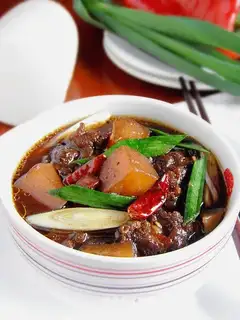 Stewed beef with radish
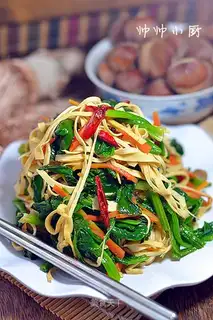 Old vinegar spinach