Since ancient times, Traditional Chinese Medicine has advocated for "the same source for medicine and food," because all medicines have some toxicity, whereas food does not harm the body and can cure illnesses in a gentle, safe, and simple manner. Through a reasonable and appropriate diet, people can not only satisfy their hunger but also treat or prevent a wide variety of diseases. Here are the nine most natural medicinal foods that are both delicious and therapeutic!
Today, I'd like to share some common "food-medicine" foods with everyone. They can treat illnesses when you are sick, and strengthen the body when you are well.
Wheat
The "Compendium of Materia Medica" states, "Wheat is sown in autumn, grows in winter, sprouts in spring, and ripens in summer. It contains the harmonious qi of all four seasons, thus it is the most precious of the five grains." It also says, "A decoction made from old wheat can stop spontaneous sweating." Furthermore, wheat bran is high in dietary fiber and has preventive and therapeutic effects on hyperlipoproteinemia, diabetes, atherosclerosis, hemorrhoids, senile constipation, and colon cancer.
Dietary Therapy:
For "women's visceral agitation" due to insufficient heart blood, manifesting as insomnia, dream-disturbed sleep, palpitations, constant yawning, a tendency to sadness and weeping (equivalent to menopausal syndrome): you can cook a soup with wheat, Chinese red dates, and licorice and eat it together.
For those with deficiency and spontaneous sweating or night sweats: it is advisable to use floating wheat (immature young wheat that floats when washed) decocted with Astragalus root and Chinese red dates.
For lactating mothers to stop milk production: use raw malt to make a decoction for oral consumption.
Brown Sugar Wheat Germ Bread
Job's Tears
Job's Tears is highly nutritious and is hailed as the "king of world gramineous plants." In Europe, it is known as the "grain of life and health." In Japan, Job's Tears is considered a typical "anti-cancer food" and can also alleviate the toxic side effects of chemotherapy and radiotherapy for cancer patients.
Dietary Therapy:
To expel dampness: boil a handful of Job's Tears and a handful of red adzuki beans (no need for a strict ratio) into a soup. Do not add rice, because both adzuki beans and Job's Tears are dampness-expelling and do not contain dampness themselves, while rice grows in water and contains dampness. Dampness is sticky, and once added, its efficacy is greatly reduced. This Job's Tears and adzuki bean soup can also strengthen the spleen and stomach, reduce swelling and aid in weight loss, and relieve constipation.
To strengthen the spleen and nourish the stomach: 200g of Job's Tears, soaked for 2 hours first, 20g of Codonopsis root, 50g of Chinese red dates, cooked into a congee.
To clear the lungs and stop coughing: 200g of Job's Tears, soaked for 2 hours and cooked into a congee until just done. Add 50g of lily bulb, 50g of fresh lotus root, 50g of white radish, and a little rock sugar. Simmer for another 20 minutes.
Job's Tears and Winter Melon Soup
Carrot
The "Compendium of Materia Medica" states: "Carrot lowers qi, tonifies the middle jiao, benefits the chest, diaphragm, stomach, and intestines, pacifies the five organs, makes one's appetite healthy, and is beneficial without harm." American scientists have confirmed that eating 2 carrots a day can lower blood cholesterol by 10-20%; eating 3 carrots a day helps prevent heart disease and tumors. The Dutch have even designated it as their "national dish."
Dietary Therapy:
For early-stage hypertension: 500g of carrots, 500g of celery, washed and cut into pieces. Put them in a juicer together. Drink once in the morning and once in the evening. It is best to take it continuously for 30 days.
For stomach and duodenal ulcers: 150g of carrots, peeled and cut into pieces; 500g of lamb, washed; 15g of dried tangerine peel; 30g of ginger; appropriate amount of salt and peanut oil. Heat a wok, add oil, and when it's nearly hot, stir-fry the lamb, carrots, ginger, and tangerine peel together. Add water, bring to a boil, then reduce the heat and simmer until the lamb is tender. Eat as a dish with lunch and dinner daily.
Shredded Carrot Salad
Kiwi
Kiwi is extremely nutritious, containing more than 10 kinds of amino acids, rich minerals, carotene, and multiple vitamins. Its Vitamin C content is over 100mg, which is 5-10 times that of citrus and 15-30 times that of other fruits like apples. Therefore, kiwi is known as the "king of fruits" in the world.
Dietary Therapy:
To treat indigestion: 60g of dried kiwi fruit, add 1000ml of water and simmer until it reduces to a small bowl. Take one dose daily.
Eating 60g of raw, peeled kiwi fruit can treat internal heat and vexation, and prevent and treat scurvy, hypertension, cardiovascular diseases, and cancer.
Kiwi Smoothie
Chinese Yam
Chinese Yam is listed as a superior medicinal herb. It has the effects of securing the kidneys and replenishing essence, strengthening the spleen and supplementing the lungs, benefiting the stomach and kidneys, making one's ears sharp and eyes bright, helping the five organs, strengthening muscles and bones, boosting willpower and calming the spirit, and prolonging life. It can also stop diarrhea, promote urination, and resolve phlegm, and is very effective for poor appetite, loose stools, wheezing and coughing, frequent urination, and thirst.
Dietary Therapy:
Chinese Yam and Corn Congee: for cancer prevention, replenishing qi, and strengthening the spleen. 90g of corn (yellow, dried), 60g of Chinese yam, 50g of lotus seeds, 30g of rock sugar. Cut the Chinese yam into fine shreds, remove the cores from the lotus seeds and grind them into powder. Put the corn and Chinese yam in a pot with an appropriate amount of water and cook for 30 minutes. Then add the lotus seed powder and rock sugar and cook into a thin, congee-like paste. It has the effects of preventing cancer, replenishing qi, and strengthening the spleen.
Oat and Chinese Yam Congee: for deficiency of both the spleen and kidneys. 50g of rolled oats, 100g of fresh Chinese yam sliced, cook together with water into a congee. This formula is suitable for patients with spleen and kidney deficiency, to be taken once daily.
Chinese Yam, Hyacinth Bean, and Lotus Seed Congee: for spleen deficiency with diarrhea and palpitations. 15g of white hyacinth beans, 15g of Chinese yam, 15g of lotus seeds, 50g of japonica rice. Cook the four ingredients into a congee. This congee strengthens the spleen and stops diarrhea, and is used for symptoms like spleen deficiency with diarrhea and palpitations.
Chinese Yam and Corn Congee
Black Fungus
Black fungus is a dual-purpose food and medicine, praised by nutritionists as the "meat among vegetables" and a high-quality blood tonic. It is also regarded as a natural dust collector and the "aspirin" of food.
Modern science believes that black fungus is rich in various vitamins, especially iron, with an iron content 100 times higher than that in meat. Therefore, black fungus is an excellent food for patients with iron-deficiency anemia.
Black fungus also has the function of moistening the intestines and detoxifying. The adenosine in black fungus has a significant effect on inhibiting thrombosis, making it an excellent health food for middle-aged and elderly people.
Dietary Therapy:
Black Fungus and Mushroom Soup: 10g of black fungus, 50g of mushrooms, 10g of ginger, 3g of salt, cooked into a soup. Take 2-3 times daily to treat diabetes.
Black Fungus and Tofu: 15g of black fungus, 60g of tofu, appropriate seasonings. Stir-fry and eat once daily. Long-term consumption is effective. It can replenish qi and invigorate blood, and can prevent and treat coronary heart disease and arteriosclerosis.
Black Fungus and Chicken Liver Stir-fry: 20g of black fungus, 100g of chicken liver, stir-fry and eat. Take 1-2 times daily. It can nourish blood and stop bleeding, and treat anemia.
Braised Tofu with Black Fungus
Winter Melon
Winter melon is a vegetable that is both a food and a medicine, with multiple health benefits, including moistening the lungs, generating fluids, transforming phlegm, and quenching thirst, as well as promoting urination and reducing swelling. Modern medical research has confirmed that winter melon can also lower blood pressure, protect the kidneys, aid in weight loss and reduce lipids, and beautify the skin.
Dietary Therapy:
For heatstroke, high fever, and coma: 500g of winter melon, boiled into 3 large bowls of soup, to be taken in 3 doses throughout the day.
For chronic nephritis: 1000g of winter melon, 1 carp (about 300g), cooked into a soup without salt to be eaten.
For edema: 100g of winter melon peel, 30g of corn silk, 30g of cogon grass rhizome, decocted in water, taken 3 times daily. Or, 1000g of winter melon, 100g of red adzuki beans, stewed until soft and the soup is consumed, twice daily.
Winter Melon Soup
Peanut
Peanuts are called "longevity fruit" by people and have also been designated by NASA as astronaut food. The protein it contains is comparable to that of animal foods like eggs and milk, earning it the reputation of "vegetable meat" and "meat among vegetables."
Dietary Therapy:
Vinegar-soaked peanuts: to soften blood vessels. Soak peanuts in vinegar for more than one week. Eat 7-10 peanuts every night. One course of treatment lasts for one week, which can lower blood pressure, soften blood vessels, and reduce cholesterol buildup.
Stewed pork trotters with peanuts: to relieve constipation. 3 liang (150g) of peanuts, 1 pig's trotter, stewed into a soup and eaten. Eat one serving daily for one week to greatly relieve constipation.
Peanut water: to protect the throat. 80g of red-skinned peanuts, boiled in water. Eat the peanuts and drink the soup, 1-2 times daily, to protect the throat and has a certain therapeutic effect on hoarseness and loss of voice.
Vinegar-soaked Peanuts
Black Soybean
According to Traditional Chinese Medicine, black soybeans are very nutritious, containing fat, protein, carbohydrates, vitamins B1, B2, niacin, carotene, and minerals such as calcium, iron, phosphorus, and potassium. It is particularly noted that the protein content of black soybeans is especially rich, higher than that in meat, eggs, and milk, earning it the reputation of "king of plant proteins."
Dietary Therapy:
To treat rheumatic arthralgia: 100g of black soybeans, 100g of ginger, 60g of papaya. Boil in water until the beans are soft. Eat the beans and drink the soup, once a day, for 3-5 consecutive days.
To treat hypertension: Soak 100g of black soybeans in 500ml of water for 5-6 hours, then simmer over low heat until the liquid is reduced by half. Filter out the soy milk with a cheesecloth and take 2-3 times. This formula is also beneficial for those with high blood sugar.
For scalds: 250g of black soybeans, boiled into a strong decoction. Apply an appropriate amount to the affected area.
Vinegar-soaked Black Soybeans
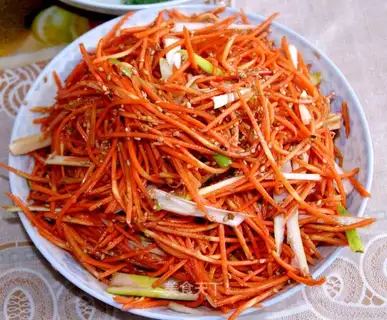 Shred carrot salad
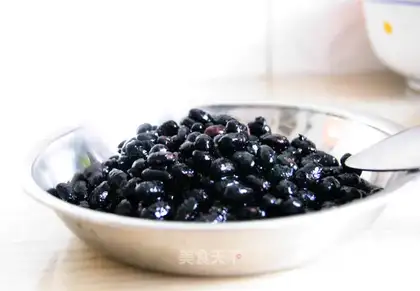 Black beans soaked in vinegar
 Coix rice and white gourd soup
 ♪ The chrysanthemum ice ♪
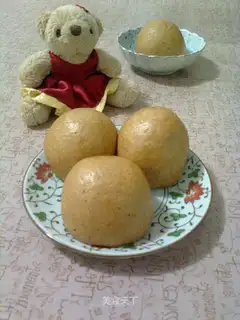 Red sugar wheat embryos
 Pork soup
 Porridge
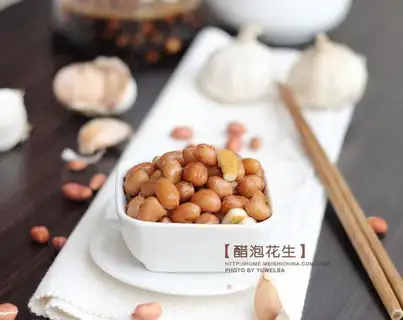 Jealous peanuts
 Peach omelet