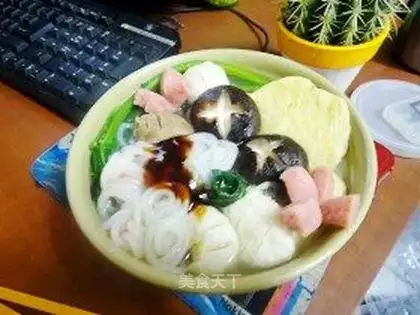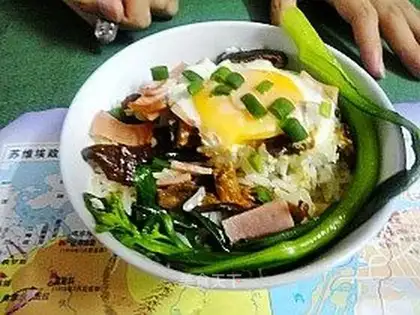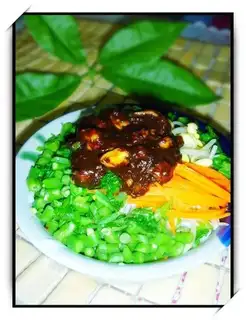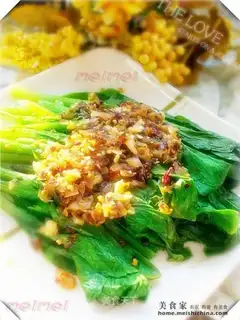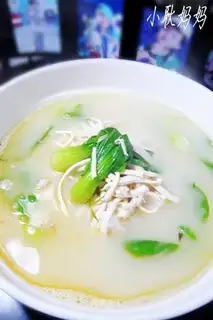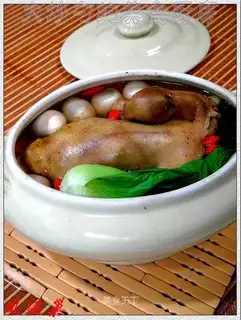
"Phoenix Returns Nest" is a famous historical dish in Suzhou. It is said that in the past, in Suzhou and Wuxi, when the daughters of large families married, they would take their son-in-law back to their mother's family three days later to visit relatives to thank their parents for raising them. <br />In ancient times, sons-in-law were all distinguished guests and were warmly welcomed when they visited the family of the father-in-law in Mount Tai. During the banquet, my son-in-law drank wine and chatted happily and asked him to take good care of his daughter. This was a ritual at that time. Even poor families eat better than usual to entertain their son-in-law. This "phoenix returns to its nest" is a soup dish that daughters of large families must serve when they return to their homes. Of course, ordinary people do not have such a delicious taste in their homes. <br />"Phoenix Returning to Nest" is actually a very simple soup dish. The main food eaten is the delicacy of the raw materials and its original flavor. This dish is usually made with "pigeons". It is stewed with the soup and meat. It tastes very delicious and has a tonic effect. This dish was mentioned in both "Suiyuan Food List" and "Yangzhou Painting Boat Record" written by Yuan Mei in the Qing Dynasty, but the name is only different. <br />When Qianlong went down Jiangnan Road and passed through Suzhou, local officials once served him with this dish. The emperor felt very delicious after eating it, and the name was elegant! It can be said that it is true; there are thousands of beautiful things in the world, which is no better than Suzhou's "phoenix returning to its nest". <br />It is said that when Qianlong held a banquet for the first time in honor of local Manchu and Han officials in the Tianning Temple Palace in Yangzhou, the entourage of the Internal Affairs Office specially ordered people to prepare this "phoenix returning to its nest" ritual. "Tianning Temple" was also the first place for the "Manchu and Han Feast" at that time. According to records, the banquet was held very lavish and grand. It can be said to be extravagant and luxurious, and it attracted all the delicacies of Jiangnan. <br />The Qianlong period of the Qing Dynasty was a heyday for the development of food in my country. Based on the Kangxi "Thousand Sou Banquet", it established the "Manchu and Han Banquet" that was later recognized by people. The "Manchu and Han Feast" gathers the essence of Chinese food on one seat, adding more vivid content to China's food culture! <br />Later, many restaurants used "chicken" as raw material to "return the phoenix to the nest", and it became mainly meat. In fact, its original method was to mainly drink soup. Today, we will make this "Phoenix Returns Nest". The main productions are as follows;
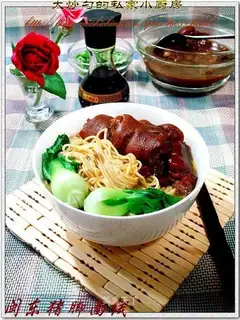
For Fujianese and Hakka people,"noodle line" is a kind of pasta that symbolizes longevity and good fortune. It also has the significance of using it to exorcise evil spirits, eliminate bad luck, ensure peace, and reunite the family. <br />Elderly people celebrate birthdays, children eat noodle thread on birthdays, noodle thread on festive days, men eat noodle thread after returning from fishing, wanderers return or distant relatives return to their hometowns, noodle thread after getting rid of bad luck, and so on. In short, since ancient times, the noodle line has been a kind of pasta that symbolizes good fortune, longevity, and peace in Fujian and Taiwan, and prays for relatives. <br />There are many ways to make "noodle line", including fish round noodle line, seafood noodle line, fried noodle line, etc., but these are just general ways to eat. The real thing to eat noodle line to pray for blessings is usually to eat "pig's foot noodle line", which is a custom inherited from Fujian and Taiwan. <br />Hakka people in Fujian are the most particular about this. Every time I go to Fujian on a business trip, I always have to stay at my distant great-aunt's house for two days, and my first meal every time is to eat noodles. Later, I heard my cousin say: "This is the old man praying for me, for my health, for my career, for my happiness, etc. She is praying for me from the bottom of her heart, and may everything be well for me in my life." Although grandma didn't say it out loud, all her good wishes were condensed into a bowl of exquisite flour. That time, after listening to my cousin's explanation, I was deeply grateful to the old man for his blessings. I am old, but I still have deep concern for my younger generation! I wish grandma health and longevity! <br />Today, make a bowl of noodles, pray for my family, distant relatives and all friends, and wish everyone health, peace and happiness! <br />The practice of "pig's foot flour thread" is as follows;