salty and fresh Recipe
TitoBerge
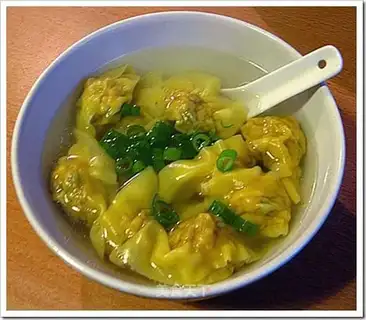
Wonton, a traditional food in China, originated in northern China. Ancient China believed that this was a sealed steamed bun with no seven orifices, so it was called "chaos." Therefore, people extended eating wontons to "break chaos and open up heaven and earth." Dumplings have not changed significantly for thousands of years, but wontons have flourished in the south and gained an independent style. Since its development, wonton has become a famous snack made in various ways and is deeply loved by people. Wonton has many names. Most places such as Jiangsu and Zhejiang call it wonton, Guangdong calls it wonton, Hubei calls it Bao Noodle, Jiangxi calls it Qingtang, Sichuan calls it wonshou, Xinjiang calls it ququ, etc. Our country has always had a proverb "Winter Solstice Wonton and Summer Solstice Noodles". In a sense, wonton has become a representative of southern food culture. <br /><br />In ordinary Shanghai families, dumplings are rarely eaten, which conforms to the custom of southerners not eating dumplings. Wonton, on the other hand, is a home-cooked food suitable for all ages. The names of wontons in Shanghai are divided into "big wonton","medium wonton" and "small wonton" according to their heads. Such names are also a major feature of local wontons in Shanghai. The wrapping method for large wontons and medium wontons is the same. They are both ingot shaped. The large wontons are mainly vegetables and meat, while the medium wontons and small wontons are mostly filled with pure meat. The wrapping method for small wontons is very simple, and it is easy to squeeze it at will. In addition, Shanghai wontons, no matter how big or small, are generally filled with pork, but never beef. The reason is unknown.